Climate Change News

I’ve seen a number of interesting articles regarding climate change in the news lately, so figured I’d just sum them up in a single post.   As always, follow the links for the full stories.

First, the World Bank has issued a report (PDF link) that finds a very high chance of hitting an average warming of 4°C by the end of this century…twice the international ‘goal’ of 2°C.  The report goes into details of why this is bad, but chances are if you’re reading this you already believe it’s bad…what is significant here is that yet another scientific report is showing we’re making too little progress towards combating climate change, and are leaving a pretty messed up world for future generations. (full article at the Washington Post).  It’s also worth noting that while the impacts of a 2°C rise have been studied quite a bit, the same scientific scrutiny has not been applied to a 4°C rise.  They conclude that, “Given that uncertainty remains about the full nature and scale of impacts, there is also no certainty that adaptation to a 4°C world is possible.”  Think about that.

Our neighbors in Canada are feeling a bit better about global warming, as it’s not expected to impact them as negatively (or other northern countries like Russia).  (link)  The warmer temperatures could even have some benefits…more tourism and increased food production, for example.

In Iowa, more than 130 scientists from Iowa colleges and universities have pointed out the obvious…that the bad drought they experienced this year is a predicted effect of global warming, and that we can and should expect more of the same (or worse) in coming years.  (link)  I wonder if this will lead to a mass exodus of people moving from the Midwest to Canada?

In light of the news that the US is on track to be a net exporter of energy by 2020, no longer dependent on foreign oil, the IEA warns that

No more that one-third of proven reserves of fossil fuels can be consumed prior to 2050 if the world is to achieve the 2°C goal.

By pursuing energy independence via increased domestic fossil fuel production, we’re also sealing the fate of future generations.  (link)

Last, but most certainly not least, is that when you look at global average temperature, October 2012 was above average…but what’s most significant is that this was the 332nd consecutive month where the global average temperature has been at or above average.  Remember, there are local variations – some parts of the world may be cooler, some hotter – but globally, the data indicates that this planet is warming up. (link)

I’d like to wrap up this post with advice for how we can stop this, but that’s a real tough one.  I’m convinced that the only solution is to provide people with a clean energy alternative at a lower cost.  More importantly, we need action fast…which means we need a dramatically lower cost, something that makes everyone rush to adopt this new technology.  I’m not aware of any technologies that fit that requirement…and our country lacks the political will to implement change on a national level.  Any ideas?

World CO2 emissions increasing

We’re doing a lousy job of fighting global warming, despite science giving us a pretty good understanding of the impacts continuing along this current path.  Rather than cut emissions, global CO2 emissions in 2011 increased by 2.5% to a new record of 34 billion metric tons, according to Scientific American.  It’s depressing that we can’t solve this problem…but the reality is, people are more worried about themselves than future generations.  Or at least, that’ll be the case until those future generations grow up and realize who’s to blame for the mess they face.

Making fuel from air

A company in England, Air Fuel Synthesis, has demonstrated a method of making a liquid hydrocarbon fuel from nothing more than air.  Well, more specifically, they say the process:

“captures carbon dioxide and water from the air, electrolyzes the water to make hydrogen, and reacts the carbon dioxide and hydrogen together to make hydrocarbon fuels”

Naturally, they believe it is a scalable process but is so far confined to laboratory volumes – they’ve produced five liters since August, which is fantastic but they have a ways to go.  What’s key here, too, is how much energy is consumed in this process, something that so far I can’t find details of.  If powered by solar or wind, though, a process like this could theoretically be nearly carbon neutral, yet still provide fuel to power cars and trucks.  Or, if coupled with a utility-scale solar panel installation, some excess solar energy could be funneled to this process during the day, producing fuel which can power generators during the night when the panels aren’t producing.
Read more over at Wired, Inhabit, or Jalopnik.

Arctic Sea Ice Vanishing

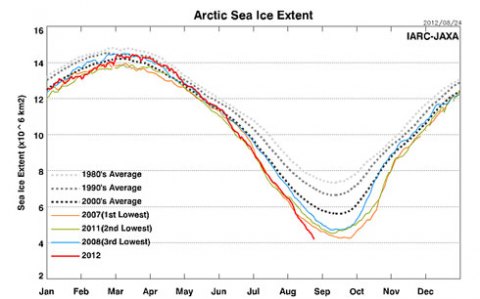
It seems to me that every year or so for the past decade, I’d see a story in the news reporting on the minimum extent of arctic sea ice, comparing it to previous years, etc.  Sometimes it’d be reaching a new minimum, sometimes it’d be the second or third worst on history.  This usually occurs around late September or early October, when arctic sea ice usually hits its minimum for the year.  So, it’s too soon to be hearing doom and gloom about the arctic this year, right, since we’re still in August?

Nope.

As the graph above shows, we probably haven’t reached the 2012 arctic sea ice minimum point yet…but we have already set a new record for minimum sea ice extent in the arctic.  If historic trends prove true, we have another month of so of melting before we reach the actual minimum for this year.  2012 is, unfortunately, providing global evidence of the impact our species is having on this planet through CO2 emissions and global warming.  While the technology exists to halt this slide into oblivion, we so far lack the willpower to do something about it. On the contrary, the Republican party is in outright denial of the issue, and a very large percentage of Americans are blindly following along.

What will it take to convince people that preserving this awesome planet for future generations to enjoy is worth a bit of personal sacrifice?\

(via climatecrocks.com)

More bad news on the climate

More bad news on climate change…a prominent scientist in the UK (Sir Robert Watson) is now saying that the goal of a 2C global temperature rise is ‘largely out of the window’ and that 5C is a more realistic expectation.  This is bad…it’ll affect food and water supplies, not to mention increasing sea levels and population displacement.  This doesn’t have to be our fate…we have the technologies needed to reduce greenhouse gas emissions dramatically, let’s us them!
Read more about this and what he has to say over at the BBC.

Are we past the point of ‘acceptable’ climate change?

Have we passed the point of ‘acceptable’ climate change, if there can be such a thing?  It’s a difficult question to answer, for climate is a complex system and our impact on it takes some time to realize.  More and more though, I’m hearing scientists speak up with concern about where we’re at now.  It would be easy to downplay that if our species was making significant progress towards reducing CO2 emissions to zero, but when you see those emissions increasing instead, you can’t help but be concerned.

The latest article I’ve found is in Scientific American, and basically talks about how the CURRENT levels of CO2 in the atmosphere are going to lead to really bad changes (‘catastrophic’ is the word used, but I like to remain at least a LITTLE optimistic…).  The scientifically agreed upon ‘goal’ for atmospheric CO2 concentration has been 350ppm (parts per million).  The problem is we’ve already passed that, currently sitting at about 390ppm with only increases in the forecast. (read more here)  The group 350.org is a great source to follow for more information about this goal, too.

The most frustrating part?  It doesn’t need to be like this.  We don’t need a revolution in technology to reduce our CO2 emissions dramatically (cutting CO2 to zero probably would require some radical new technology, but we can benefit a lot just by going after the low hanging fruit, so to speak).  The technologies already exist to provide most of our energy in clean forms…we just lack the political and social willpower to do anything about it.  Perhaps that can change…and it’s that hope that leads me to keep posting to this blog, in a perhaps futile attempt to influence others globally and enact change.

Climate Change is Simple

I really like this TED speech from David Roberts, called ‘Climate is Simple‘.  Well I like how he presents the facts…but I don’t like hearing the conclusions (though I don’t dispute them).  He sums up where the climate has been, where we’re at now, and where we’re headed.  It’s that last part that scares me…we’re on the verge of ruining this planet for future generations.  What gives us the right to do that?  I believe we should preserve this planet for future generations to enjoy…not alter it for future generations to suffer and face a lesser quality of life than us.  If you agree, it’s worth watching this video:

Climate Change Skeptics Reverse Course

Finding a climate change scientist who does NOT believe that people are responsible for global warming is pretty hard (the commonly-reported estimate is that 98% of climate change scientists are in agreement that people are mostly responsible for climate change)…and it’s getting harder.  One of the more prominent skeptics, Richard Muller, has accepted the scientific evidence and is no longer a skeptic…he was part of a team of more than a dozen scientists at the University of California, Berkeley that have been studying global warming, specifically with respect to how global warming correlates to human and natural events, to try to determine the cause.  What they found was that the average land temperature has increased by 1.5C over the last 250 years, and that “”the most straightforward explanation for this warming is human greenhouse gas emissions.”  Most of that increase has been in the past 50 years, too.

I think former skeptic Muller put it best when he said, “While this doesn’t prove that global warming is caused by human greenhouse gases, it is currently the best explanation we have found, and sets the bar for alternative explanations.”  This is what science is all about.  Recognizing the facts, but also maintaining an open mind, for science is rarely 100% certain about anything.  Perhaps some new hypothesis will be put forth that shows that CO2 is NOT responsible for global warming, but until such a hypothesis is presented and proven, we need to stop this media debate over global warming and report the scientific facts.  The media needs to stop giving air time to climate change skeptics who don’t have the science to back up their claims…for doing so only works to legitimize their ideas in the mainstream public’s minds.

The project’s official website is here, where you can view full results of this study.  Or, read more about it over at The Guardian.

26 states are natural disasters due to drought

26 states have been declared natural disasters due to drought.  Crops are withering.  While it’s not possible to tie one year of weather to climate change, this is just another data point in a continuing trend, one that’s going pretty much as climate scientists have been predicting.  Another result has been the wildfires in Colorado.  Increased rainfall in the Pacific Northwest.  These are, most likely, not ‘abnormalities’, but rather the new norm…and we’re nowhere near predicted levels of global climate warming, that’s still decades away (or more, if we don’t find a way to drastically cut CO2 levels).  If we were to slash CO2 emissions to zero this year (great TED talk from Bill Gates here on that topic), much of this could be held at the levels we see now (except that sea level rise would continue for quite some time).  The chances of that happening are zilch, I’d say.  Expect weather extremes to get worse, and be ready to adapt the best you can.

Over-consumption

No surprise here, but a recent article at phys.org talks about over-consumption on a global scale, how we’re consuming more than this planet can produce.  Think of it in terms of personal finance…we’re spending more than we’re making each money, and out savings account is going to run out (with no interstellar ‘banks’ to extend us credit!).

What I really found interesting though was the chart below, that illustrates how the carbon footprint of different food varies.  It’s amazing how bad cows are for our environment, especially compared to other meat options like pork or chicken!

Proudly powered by WordPress | Theme: Baskerville 2 by Anders Noren.

Up ↑