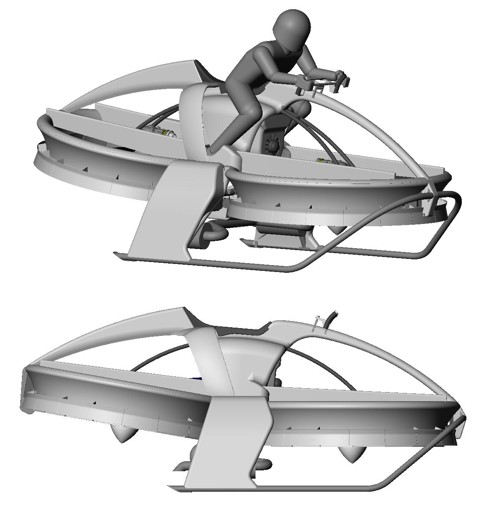
Aerofex hover bike

A real, functional hover bike!  While the image to the left is just a next generation concept image, the videos below show a functional prototype.  While it still seems a bit rough around the edges, this concept works and I can’t wait to see it evolve.  It uses ducted fans and a clever mechanical control system to enhance stability (when the rider leans, a force is applied to control bars located in the knee area).  Check out more over at Aerofex.

AR possibilities – ‘Sight’

Check out this cool video of a fictional augmented reality / contact lens application.  I find videos like these fascinating, for the potential AR applications they expose.  This video in particular hits on all the typical uses…entertainment, reality enhancement, self improvement, etc.  Also hits a bit on the darker side of this, blurring the line between being fully human, and just doing what machines tell you to do.  Worth watching (especially the end…).

Climate Change is Simple

I really like this TED speech from David Roberts, called ‘Climate is Simple‘.  Well I like how he presents the facts…but I don’t like hearing the conclusions (though I don’t dispute them).  He sums up where the climate has been, where we’re at now, and where we’re headed.  It’s that last part that scares me…we’re on the verge of ruining this planet for future generations.  What gives us the right to do that?  I believe we should preserve this planet for future generations to enjoy…not alter it for future generations to suffer and face a lesser quality of life than us.  If you agree, it’s worth watching this video:

Climate Change and Skeptics

Jerry Brown, governor of California, has a launched a new website discussing climate change…but the real gem of it is the section devoted to climate change skeptics (or ‘morons’, as I like to refer to them).  It does a good job of presenting rational responses to the arguments skeptics typically make.  Not that skeptics are interested in rational responses and those annoying things called ‘facts’, but hey, it might make you feel more confident when debating climate change with someone.  Or it might just make you depressed that only about half of Americans believe that people are responsible for this.

Check out the Climate Change Deniers section when you get a chance.

Also keep in mind that what matters with climate is the trends over several years, you can’t draw conclusions from just one year.  The past 12 months have been record-setting, sure, but using that to support your position when debating climate change puts you on thin ice (so to speak).  Stick to the science…one year is interesting, but decades are what establishes scientific fact.

July 2012 the hottest month EVER

The dust bowl summer of 1936 was a hot one, and until this year, the hottest on record.  No more.  July 2012 is officially the hottest month ever recorded in the continental US.  We also set a record for the warmest January through July period, and for the past 12 month period of time.

Climate change is real, it’s happening, and the worst part is yet to come as atmospheric CO2 levels continue to rise unchecked.  Scary stuff.

Read more here.

Peak Water – aquifer depletion

Not exactly news, but some more warning signs about depletion of underground water supplies in this article at Scientific American.  The basic problem is that agricultural demands are depleting the aquifers and eventually we won’t be able to rely on them for food production.  The good news is that around 80% of the world’s aquifers are being managed sustainably, but that 20% that’s not are critical to food production.  Combine that with global warming and an increasing planetary population, and it seems we have a serious problem looming.

One other bit of bad news…it apparently takes around 140 liters of water to grow the beans for a single cup of coffee!  Crops like that, which can be considered ‘luxury’ crops, will soon be forced aside to make room for the staples we need to survive.  Not quite time to sell your Starbucks stock perhaps, but I wouldn’t consider that a good long term investment…

Climate Change Skeptics Reverse Course

Finding a climate change scientist who does NOT believe that people are responsible for global warming is pretty hard (the commonly-reported estimate is that 98% of climate change scientists are in agreement that people are mostly responsible for climate change)…and it’s getting harder.  One of the more prominent skeptics, Richard Muller, has accepted the scientific evidence and is no longer a skeptic…he was part of a team of more than a dozen scientists at the University of California, Berkeley that have been studying global warming, specifically with respect to how global warming correlates to human and natural events, to try to determine the cause.  What they found was that the average land temperature has increased by 1.5C over the last 250 years, and that “”the most straightforward explanation for this warming is human greenhouse gas emissions.”  Most of that increase has been in the past 50 years, too.

I think former skeptic Muller put it best when he said, “While this doesn’t prove that global warming is caused by human greenhouse gases, it is currently the best explanation we have found, and sets the bar for alternative explanations.”  This is what science is all about.  Recognizing the facts, but also maintaining an open mind, for science is rarely 100% certain about anything.  Perhaps some new hypothesis will be put forth that shows that CO2 is NOT responsible for global warming, but until such a hypothesis is presented and proven, we need to stop this media debate over global warming and report the scientific facts.  The media needs to stop giving air time to climate change skeptics who don’t have the science to back up their claims…for doing so only works to legitimize their ideas in the mainstream public’s minds.

The project’s official website is here, where you can view full results of this study.  Or, read more about it over at The Guardian.
Overreacting to climate change

The droughts and wildfires that have hit this country are signs of what’s to expect with climate change in the coming years, but here’s the thing…people are, I fear, overreacting to this.  Meaning, they’re looking at what’s happening and saying that climate change is here, this is the new norm, etc.  While that’s mostly right, climate is a variable thing and you need to look at long term trends.  I have little doubt that, long term, yeah, this is the new ‘norm’.  I also have little doubt, though, that in the next year or two, we’ll probably get a lot of rain, maybe cooler temperatures, and people will then use that as an argument to attempt to refute the idea of climate change, to try to convince others that there’s no threat.  Just keep a level head about you, this year was bad, future years will seem better, but you need to look at long term trends of many years when you look at this global climate.  Those trends make it clear that the planet is warming, and what’s really scary is that we’re already experiencing bad weather, when the worst impacts of climate change aren’t forecast to happen for many, many more years to come.

Climate change may lead to ozone layer depletion

Scientists have discovered a new possible side effect of global climate change, and while it’s too early to draw any conclusions, this is a significant element that needs to be monitored closely.  They discovered that water vapor, when injected into the stratosphere by large thunderstorms, can change stable forms of bromine and chlorine into free radicals that then convert ozone (O3) into normal oxygen gas (O2).  Keep in mind that it’s the ozone layer that helps block harmful UV radiation (which causes skin cancer and could also damage the DNA of plants and animals).  Climate change is expected to lead to an increase in storm intensity, which is what makes this relevant here.  As with anything having to do with this planet’s climate, it’s a complicated issue and needs further study, but I find it interesting as it’s an angle I hadn’t considered before.

You can read more about this over at Phys.org.

Retrofit saves Empire State Building $2.4 Million in energy costs

By retrofitting the Empire State Building to improve energy efficiency, they were able to save a whopping $2.4 million dollars in energy costs over a year!  This is equivalent to around 4,000 metric tons of carbon, which is about what you’d get from planting a 750 acre pine forest.  This shows not only what can be saved by energy efficiency, but also how much energy is being wasted by many (most?) buildings on this planet.  You can read more about this in the press release.

Proudly powered by WordPress | Theme: Baskerville 2 by Anders Noren.

Up ↑