Drought-tolerant corn

The drought hitting much of the US is highlighting why genetically modified crops (or GMO, as they’re commonly referred to) are something that’s hard to avoid in our future.  As corn fields wither and die under the drought conditions, some drought-tolerance corn is doing OK, and while that particular strain is not GMO (next year should be the first production crops of GMO corn that has been engineered to be drought-tolerant), this does help show the promise of GMO in agriculture.  Instead of fields of dying corn and rising food prices, we could have just another normal, un-news-worthy year.

I still fear our current system of using humans as guinea pigs testing the safety of GMO crops, but I believe that if properly managed and scientifically tested for safety, GMO crops could go a long ways towards feeding a growing population on a planet with a changing, more extreme climate.  Frankly, I don’t see another choice.

(via TechnologyReview)

Peak Biofuel?

I’d often considered biofuel to be an interesting development, one that could hopefully replace fossil fuels, with no real downside (though not exactly carbon neutral).  However, I came across an interesting article talking about how biofuels, at least as currently envisioned, require phosphorus for growth.  Meaning, we now face a ‘peak biofuel’ situation, or rather, ‘peak phosphorus’, where biofuel production capacity can be tied to limits on phosphorus production!  Thus, while still worth pursuing, we need to be a bit more realistic in our expectations of how widely adopted biofuels can ever become.  You can read the whole article here.

Nearly Instantaneous DNA Analysis

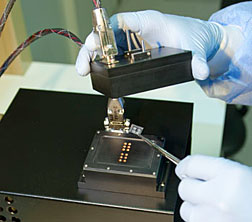
Scientists and engineers at Lawrence Livermore National Laboratory have managed to vastly decrease the time required to analyze DNA samples, by accelerating the process whereby samples are amplified for analysis.  This is expected to lead to a 5-10 minute DNA test cycle, which is a huge improvement over the hours or days it takes now.


So how will this affect you?  The example in the article at phys.org says it best, so I’ll just quote it here:


Picture this: You’ve brought your sick child to the doctor’s office. After checking her pulse and blood pressure, he takes a nasal or throat swab and inserts it into a mysterious black box. Before the doctor finishes his examination, the black box beeps, indicating that the pathogen that’s making your child sick has been identified.

(via Phys.org)

Emergency Preparation – Food

I’m going to start a new series of posts here, about preparing for emergencies.  It’s not that I expect an imminent zombiepocalypse, but it’s just a good all around idea to have the ability to be self-sufficient for a short period of time without advance notice.  Earthquakes, wildfires, power outages, and hurricanes are just some of the events that can disrupt our very complex support system.

The topic for today is food, and there’s really one clear winner here – freeze dried food in #10 size cans, such as the one pictured here from Mountain House and available with free shipping at Amazon.com.  First of all, food in cans lasts longer than any other food storage option – 25 years or more, in fact.  Second, after doing much research, Mountain House stood out as one of the highest quality options available, and given my aversion to any sort of highly processed food, that was a big plus (some of the other options looked downright scary!).

Keeping in mind that these cans of food, once opened, need to be used up fairly quickly, it’s also a good idea to have smaller packs on hand, in individual serving sizes.  For example, a Mountain House 72 hour emergency meal kit (~$55 at Amazon).  This set includes three breakfasts and six lunch/dinner entrees – so note that this would really just be a 24-hour emergency meal kit for a family of three, so order appropriately.  The downside to these smaller food pouches is a lesser, seven year shelf life.  Still, it can make for great camping or backpacking meals as it nears the end of its shelf life, at which point you can just replace your inventory with some new packs.

So how much food should you buy?  That’s a more personal question, you need to estimate what sort of disaster you’re planning for, evaluate how much food you typically have on hand in your pantry (assume your refrigerator will be un-powered and the food there will spoil fast), and how many days you’d like to be eating well (we CAN go weeks without food if needed!).  And, of course, budget comes into play.  Personally, I think a month of ’emergency food’ is not a bad start.

Arctic Sea Ice Vanishing

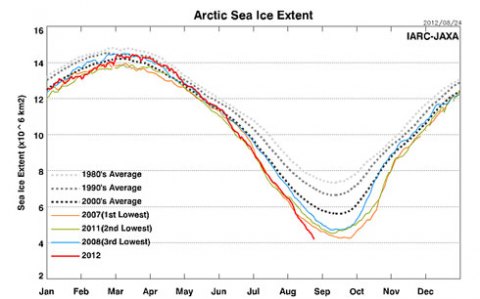
It seems to me that every year or so for the past decade, I’d see a story in the news reporting on the minimum extent of arctic sea ice, comparing it to previous years, etc.  Sometimes it’d be reaching a new minimum, sometimes it’d be the second or third worst on history.  This usually occurs around late September or early October, when arctic sea ice usually hits its minimum for the year.  So, it’s too soon to be hearing doom and gloom about the arctic this year, right, since we’re still in August?

Nope.

As the graph above shows, we probably haven’t reached the 2012 arctic sea ice minimum point yet…but we have already set a new record for minimum sea ice extent in the arctic.  If historic trends prove true, we have another month of so of melting before we reach the actual minimum for this year.  2012 is, unfortunately, providing global evidence of the impact our species is having on this planet through CO2 emissions and global warming.  While the technology exists to halt this slide into oblivion, we so far lack the willpower to do something about it. On the contrary, the Republican party is in outright denial of the issue, and a very large percentage of Americans are blindly following along.

What will it take to convince people that preserving this awesome planet for future generations to enjoy is worth a bit of personal sacrifice?\

(via climatecrocks.com)

The upside to peak plastic?

Peak Plastic is the idea that the supply of plastic (which is limited by oil, for the most part) will be less than the demand…and in all likelihood, this will happen within our generation.  I came across an interesting view on this at BoingBoing…that is, when plastic prices get high enough, there may be value in digging up the vast amounts of plastic buried in landfills and recycling that.  Mining raw materials, in essence.  Since plastic takes a very, very long time to decompose, it’s not as far-fetched as it may sound.  There are still advanced engineering plastics that need to be made from raw materials (polycarbonate, ultem, etc), but for many consumer applications, recycled commodity plastics may be perfectly suitable.

More money spent bailing out banks than on science

In the UK, professor Brian Cox claims that the UK has spent more money saving banks in a year, than it has spent on science for the past two thousand years (“since Jesus”).  It’s a bizarre claim, but when you look at the size of the bank bailouts, it certainly seems plausible. (source:BBC)

More bad news on the climate

More bad news on climate change…a prominent scientist in the UK (Sir Robert Watson) is now saying that the goal of a 2C global temperature rise is ‘largely out of the window’ and that 5C is a more realistic expectation.  This is bad…it’ll affect food and water supplies, not to mention increasing sea levels and population displacement.  This doesn’t have to be our fate…we have the technologies needed to reduce greenhouse gas emissions dramatically, let’s us them!
Read more about this and what he has to say over at the BBC.

Are we past the point of ‘acceptable’ climate change?

Have we passed the point of ‘acceptable’ climate change, if there can be such a thing?  It’s a difficult question to answer, for climate is a complex system and our impact on it takes some time to realize.  More and more though, I’m hearing scientists speak up with concern about where we’re at now.  It would be easy to downplay that if our species was making significant progress towards reducing CO2 emissions to zero, but when you see those emissions increasing instead, you can’t help but be concerned.

The latest article I’ve found is in Scientific American, and basically talks about how the CURRENT levels of CO2 in the atmosphere are going to lead to really bad changes (‘catastrophic’ is the word used, but I like to remain at least a LITTLE optimistic…).  The scientifically agreed upon ‘goal’ for atmospheric CO2 concentration has been 350ppm (parts per million).  The problem is we’ve already passed that, currently sitting at about 390ppm with only increases in the forecast. (read more here)  The group 350.org is a great source to follow for more information about this goal, too.

The most frustrating part?  It doesn’t need to be like this.  We don’t need a revolution in technology to reduce our CO2 emissions dramatically (cutting CO2 to zero probably would require some radical new technology, but we can benefit a lot just by going after the low hanging fruit, so to speak).  The technologies already exist to provide most of our energy in clean forms…we just lack the political and social willpower to do anything about it.  Perhaps that can change…and it’s that hope that leads me to keep posting to this blog, in a perhaps futile attempt to influence others globally and enact change.

Proudly powered by WordPress | Theme: Baskerville 2 by Anders Noren.

Up ↑