DNA photographed

Using some cool trickery with silicon nanopillars and an electron microscope, scientists in Italy managed to photograph and actual strand of DNA, including the closeup image below where you can start to make out the double helix structure.  Impressive work!

You can read more about it in The Atlantic.

NASA finds plastic on Mars ( UPDATE:hoax)

NASA has just issued a press release where they state that the Curiosity rover has found PLASTIC on Mars! It’s in the form of small, eighth inch diameter plastic spheres, of a type of plastic that, as far as we know at least, can only be formed using petrochemicals. This suggests there could possibly be a source of oil on Mars…and the oil that would produce this sort of plastic is only known to come from ancient fossilized organic materials like zooplankton and algae. So this raises all sorts of questions…where did the oil come from…does that mean there was once life on Mars…and how was it turned into plastic? It’s amazing what we’re learning from one solitary robot cruising the surface of Mars with limited scientific capability…there’s so much more to learn from that planet!

UPDATE: well that’s embarrassing…it looks like I fell for a hoax, this story is not true.

Cool bicycling lights

If you’re biking on the roads in the dark, you might be interested in these lighting solutions which dramatically enhance your visibility.  The first, pictured here, is not a shipping product yet, just a concept…but looks interesting.  It uses a laser to project a ‘safety zone’ on the ground around you to increase your visibility to drivers, and also to signal turns.  Read more about it here.

I saved the best for last though.  Shipping now (for $250) is a wheel-mounted LED lightning solution from Revolights that is somewhat reminiscent of the Tron light cycles. Each wheel gets 8 LEDs, but those LEDs are switch off and on, depending on the wheel position…with the next result being a band of red LEDs on the back of the rear wheel, and a band of white LEDs at the front of the front wheel.  Check out the video below to see these in action.

Burger-making machine

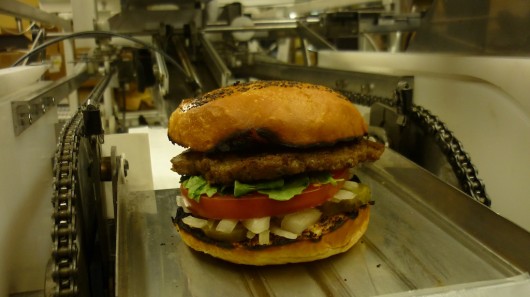
Watch out, burger flippers of the world…Momentum Machines is looking to put you out of work with their new hamburger-making machine.  It slices the toppings on demand, offers custom meat grinds (mixing multiple meats, for example), and can produce around six burgers per minute.  This photo here is of an actual burger produced by the machine, and you know what?  It looks like the promotional pictures restaurants use for their burgers…you know, the pictures that look NOTHING LIKE the actual burger they serve you.  After the horrible experience I had at McDonald’s over the weekend (see the picture below)…I think this is the coolest machine ever made.  Read more about it over at Gizmag.

This was half of the Angus burger McDonald’s served me over the weekend. Sloppy construction. Giant glob of mayo (not shown). A couple slices of onions (when I has specifically asked for NO ONIONS).  If this is the best humans can do, I’d rather have a machine-made burger!

Now that’s a fast sailboat!

For some people, sailing is a slow, relaxing hobby, a time to be at peace with the ocean and go where the wind takes you.  Of course, like any human endeavor, someone wants to be the best…or in the case, the fastest.

Paul Larsen sailed the Vestas Sailrocket 2 to a world record speed of 68mph (59.38knots, or 110km/h)!  That’s blindingly fast for any board, where 10-15mph feels ‘fast’ to most people. Awesome.  The boat is purpose-built for this effort, and the technology behind it is really cool – check it out at the official website.  Check out the video below, too!

The rise of ocean levels

Check out this chart (from phys.org)…while at first glance it shows the rise in ocean levels over the past twenty years, more importantly, it shows how when it comes to climate, you need to look at multi-year trends, not what’s happening in one particular year.  This chart shows that ocean levels actually decreased in 2010-2011, and if you only looked at that fact, you might think that there’s no cause for alarm.  However, look at the longer trend and you’ll see a very different story.

Oh, as for WHY the ocean levels dropped…that period coincided with a strong La Niña effect which temporarily shifted more than normal water from the ocean to the continents (via rainfall), a short-term effect that was canceled out once that water finished making its way back to the oceans.

Climate Change News

I’ve seen a number of interesting articles regarding climate change in the news lately, so figured I’d just sum them up in a single post.   As always, follow the links for the full stories.

First, the World Bank has issued a report (PDF link) that finds a very high chance of hitting an average warming of 4°C by the end of this century…twice the international ‘goal’ of 2°C.  The report goes into details of why this is bad, but chances are if you’re reading this you already believe it’s bad…what is significant here is that yet another scientific report is showing we’re making too little progress towards combating climate change, and are leaving a pretty messed up world for future generations. (full article at the Washington Post).  It’s also worth noting that while the impacts of a 2°C rise have been studied quite a bit, the same scientific scrutiny has not been applied to a 4°C rise.  They conclude that, “Given that uncertainty remains about the full nature and scale of impacts, there is also no certainty that adaptation to a 4°C world is possible.”  Think about that.

Our neighbors in Canada are feeling a bit better about global warming, as it’s not expected to impact them as negatively (or other northern countries like Russia).  (link)  The warmer temperatures could even have some benefits…more tourism and increased food production, for example.

In Iowa, more than 130 scientists from Iowa colleges and universities have pointed out the obvious…that the bad drought they experienced this year is a predicted effect of global warming, and that we can and should expect more of the same (or worse) in coming years.  (link)  I wonder if this will lead to a mass exodus of people moving from the Midwest to Canada?

In light of the news that the US is on track to be a net exporter of energy by 2020, no longer dependent on foreign oil, the IEA warns that

No more that one-third of proven reserves of fossil fuels can be consumed prior to 2050 if the world is to achieve the 2°C goal.

By pursuing energy independence via increased domestic fossil fuel production, we’re also sealing the fate of future generations.  (link)

Last, but most certainly not least, is that when you look at global average temperature, October 2012 was above average…but what’s most significant is that this was the 332nd consecutive month where the global average temperature has been at or above average.  Remember, there are local variations – some parts of the world may be cooler, some hotter – but globally, the data indicates that this planet is warming up. (link)

I’d like to wrap up this post with advice for how we can stop this, but that’s a real tough one.  I’m convinced that the only solution is to provide people with a clean energy alternative at a lower cost.  More importantly, we need action fast…which means we need a dramatically lower cost, something that makes everyone rush to adopt this new technology.  I’m not aware of any technologies that fit that requirement…and our country lacks the political will to implement change on a national level.  Any ideas?

Putting old hybrid car batteries to good use

When people talk about how long the batteries in hybrid and electric vehicles last, keep in mind that the battery is still usable at the end of its ‘life’, it just has decreased capacity (around 80% of its original capacity seems to be a common number there).  It’d be a shame to recycle a battery with so much energy storage potential…which is why it’s nice to see things like this system from GM, designed to use the cast-aside batteries from their Volts (once they get to that age, that is…it’s still a very new car).  One of the systems shown here provides enough energy storage to power three to five average homes, so a more likely use would be in an off-grid system in a larger building, for example.  It’s an imperfect solution, but this is an emerging market and it’s nice to see that hybrid batteries have a good chance of finding life beyond the pavement.

(via Inhabitat)

Proudly powered by WordPress | Theme: Baskerville 2 by Anders Noren.

Up ↑