Multi-use Titanium Dioxide “wonder material”

scientistScientists at Nanyang Technological University have found that by turning titanium dioxide (TiO2)crystals into nano-fibers, you can then use those fibers to make flexible filter membranes.  Those membranes can be combined with other materials, like copper, zinc, or tin, depending on what you want the final membrane to do.  So, what would you use such a membrane for?  That’s where things get really interesting, and why some are calling this a ‘wonder material’.  Here’s a short list of some of the potential applications:

  • concurrently produce both hydrogen and clean water when exposed to sunlight
  • be made into a low-cost flexible filtration membrane that is anti-fouling
  • desalinate water as a high flux forward osmosis membrane
  • recover energy from waste desalination brine and waste water
  • be made into a low-cost flexible solar cell to generate electricity
  • doubles battery life when used as anode in lithium ion battery
  • kill harmful microbial, leading to new antibacterial bandages

The potential is amazing…read more at: http://phys.org/news/2013-03-scientist-multi-purpose-material-tackle-environmental.html#jCp

Sabotaging creativity

There’s a neat article over at Fast Company about sabotaging creativity.  It deals with the issue that I think  many creative people have (myself included)…we create lists of projects, articles, whatever, that we want to tackle in the future.  The gist of this article is the idea that the existence of that list itself hurts creativity more than it helps.  I for one have a huge list of topics I’ve wanted to write about here…yet I find myself focusing instead on whatever captures my interest at a particular time.  I’m thinking lists like this are really more useful for project managers who are in a position to delegate these tasks to others.  For self-led creative types, these lists really don’t help all that much.  I can’t bring myself to delete my lists…yet…but maybe someday. 🙂

(read more at Fast Company)

Abu Dhabi now home to the world’s largest Concentrated Solar Power Plant

shams-1-21-537x331The world’s largest concentrated solar power plant has been switched on in Abu Dhabi recently.  At a cost of about $600 million, it covers almost a square mile and will generate enough electricity to power around 20,000 homes.

Read more at inhabitat.

Don’t expect this ‘world’s largest’ title to last though.  California will soon be home to some mega-plants, each powering around 100,000 homes (though not expected to be operational until 2016).

FDA may allow unlabled use of Aspartame in Milk

The International Dairy Foods Association (IDFA) and the National Milk Producers Federation (NMPF) are asking the FDA to allow them to include Aspartame in milk without having to add any labeling indicating that this ingredient has been added.  Worse, it would apply to any artificial sweetener.  Consumers would have no indication that what they’re drinking may not be pure milk, but have artificial ingredients added.  It requires an incredible stretch of the imagination to see how this could be good for consumers, but that is the reality of the food production system that we have created and support in this country.

The government is accepting public comments on this issue through 5/21; follow this link.

For more on this issue, check out this article….it’s long but has a lot of good information in it and is worth reading!

Study finds 84% of all fish have unsafe levels of mercury

fish-2961289136516LOiThis is one of those stories I find almost too scary to be true…yet I don’t see reason to doubt it.  A study by the Biodiversity Research Institute (link) found that 84% of fish have levels of mercury that are unsafe, posing a health risk to humans.  So on the one hand, we’re told to eat more fish, it’s good for you…yeah well except for the mercury part of it. 🙁  Relative to other countries, fish in the US tested better, with a bit more than 40% of samples above the recommend mercury levels.  Most other countries ranked higher, in the 90+% range.  Swordfish and tuna rank as the worst (highest mercury concentrations).

(via CBS News)

Small-scale investing in solar

Interested in investing in solar, but at a smaller level than some multi-megawatt facility?  Then check out Mosaic.  I’m not affiliated with them and am not a current investor, but it’s a neat business model that I thought I’d pass along.  They treat your investment like a loan, to fund smaller scale solar energy projects.  Most projects listed are returning 4.5%, so it’s not some get rich quick scheme, but not a bad investment all in all.

Part Design for 3D Printing on a Cube

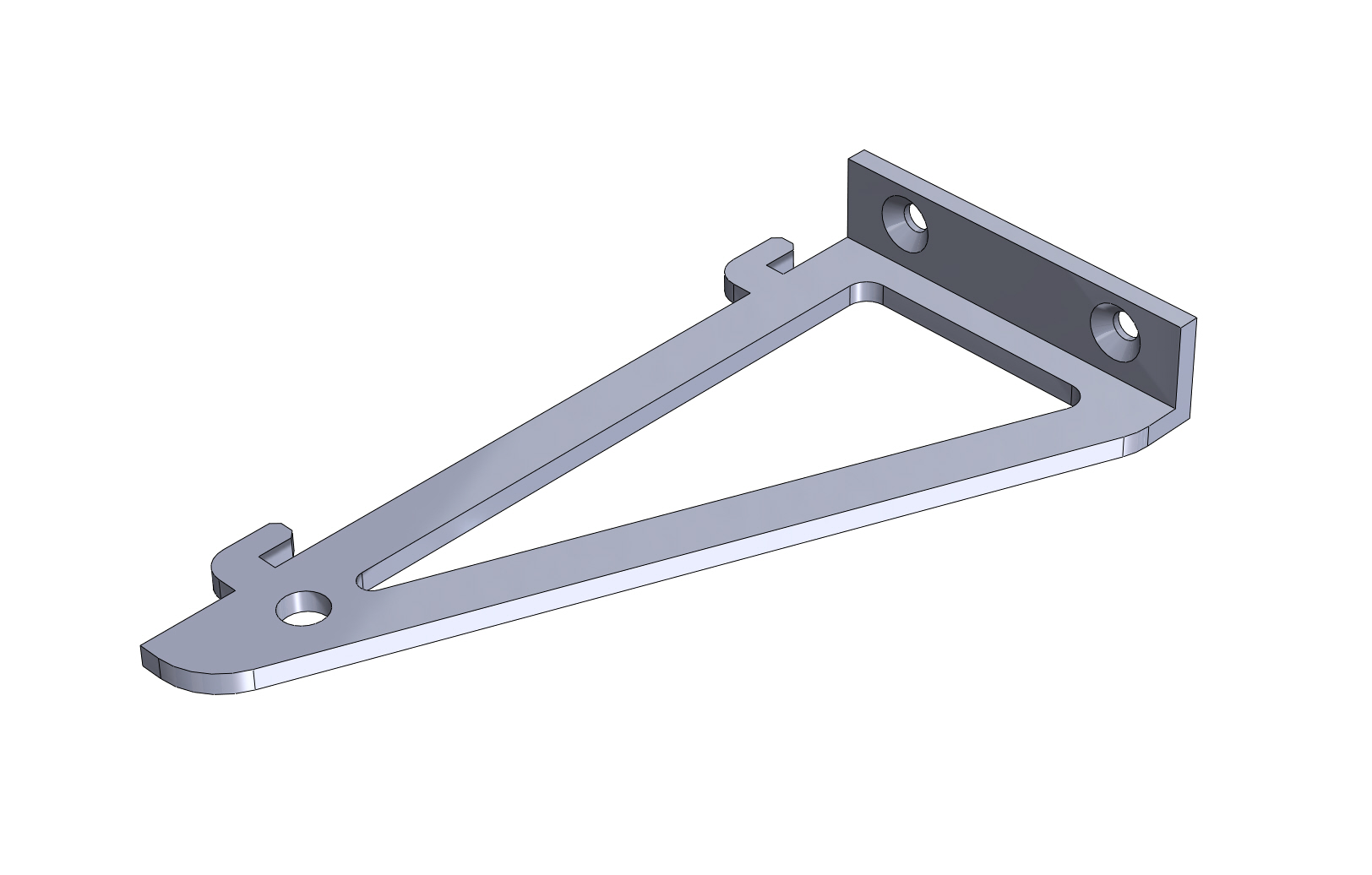
bracket_originalI’ve been really enjoying my Cube printer, but it has not been without its learning curve.  Like any part design, you need to design the part with the manufacturing process in mind, and I’m learning quite a bit about extruded filament part production.

One issue is that large parts with thick sections tend to warp.  The Cube software provides an option for a raft – basically a lattice of thin lines laid down first, providing a stable bed upon which to build the part – but this greatly increases the post-processing time.  Namely, you need to scrape or sand off the raft.  It’s not a huge deal but does waste material and time.

Consider the bracket design shown above.  It’s simple enough, with a uniform cross section and was designed to be printable without needing supports (thin webs of material to support overhangs and such).  However, when printing, this part would warp and curl, forcing me to abort the print.

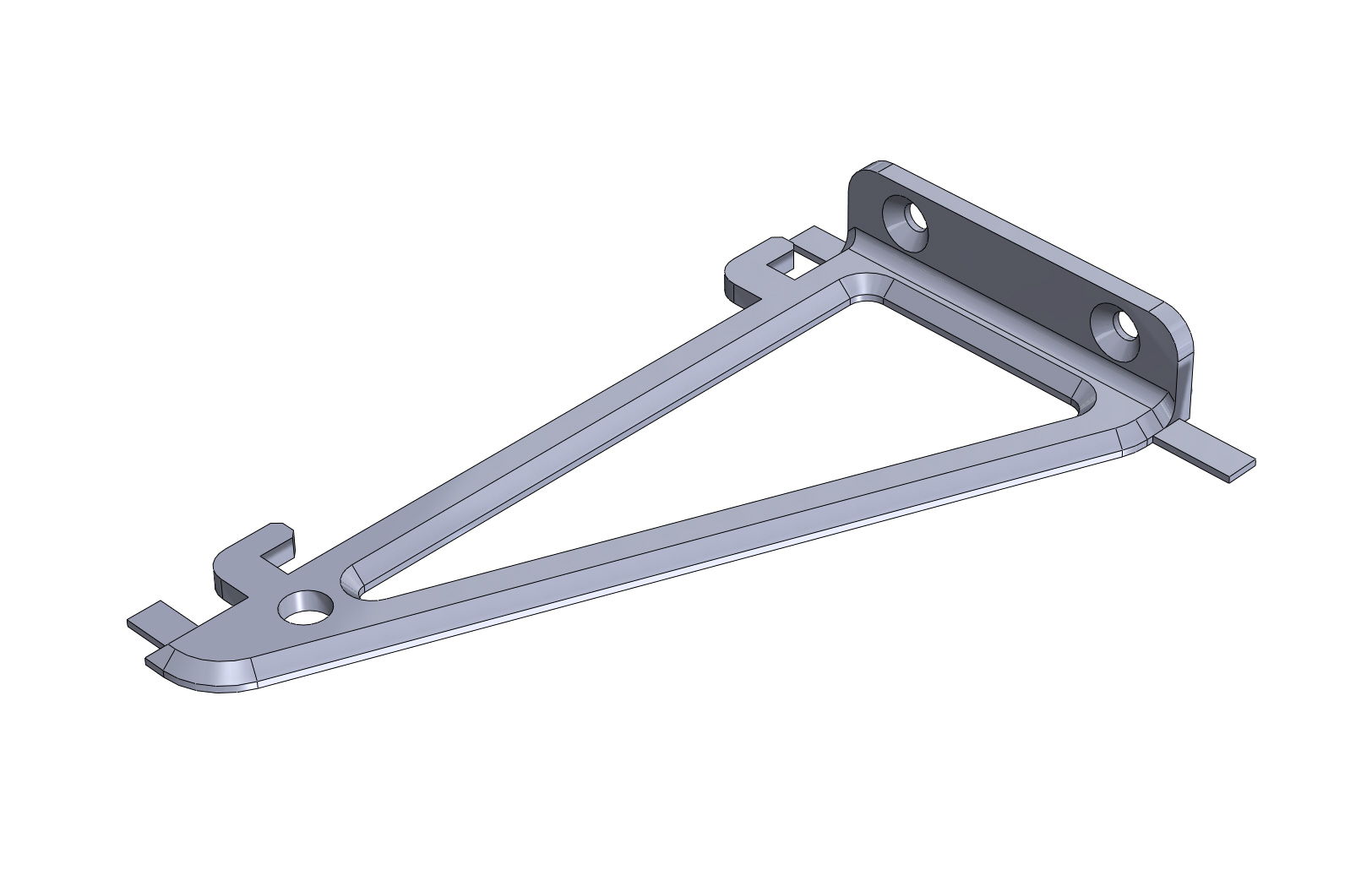
To address this, I did a few things.  First, I added thin tabs at the corners to help hold those down.  The principle is similar to the raft, but much easier to clean up (just cut them off – very quick and clean).  This alone did not produce a repeatable, printable part.  So, I added large chamfers at all edges, to reduce the part thickness and reduce warping.  This did the trick, and I was able to repeatedly print this (I’m using ABS, for what it’s worth).  Here’s what the final design looks like:

bracket_mod

As I learn more, I’m just not seeing how this technology is ready for mainstream home use like some articles seem to suggest.  You need to be a tinkerer and know your way around CAD to get parts that are really going to do what you want.  For that type of person though, this printer is fantastic!  I’ve been able to iterate prototype parts much quicker than before and am producing better designs, faster.

Bionic arm improving quality of life

Check out the video below of a bionic arm and what a bit difference it can make in one person’s quality of life.  Even with relatively simple motions (open, close, rotate), it facilitates things like tying shoes, walking the dog, etc.  Cool technology.

Proudly powered by WordPress | Theme: Baskerville 2 by Anders Noren.

Up ↑