Plug and play solar energy storage system for the home

Bosch-BPT-S5-Hybrid3Bosch is selling a near plug and play energy storage system for home use, the BPT-S 5 Hybrid, a refrigerator-sized cabinet that houses a large battery, charge controller and inverter, to simplify integration with a house’s existing solar and grid lines.  Installation is estimated at a mere two hours!  It’ll charge up when your solar panels are producing excess energy, and discharge that into your house as needed at night.  Unfortunately…it’s only available in Germany at this point. 🙁

Archos jumps into the connected device market in a big way

archos-smartwatch-press-leadArchos unveiled a slew of new connected products in advance of CES, targeting two main areas.  The first is an array of products that’s very similar to Withings to help you track your personal fitness – a wrist-mounted activity tracker, a blood pressure monitor, and a wifi-enabled scale, everything syncing to a smartphone app.  The second set of products falls into the connected home category – a weather station and wifi camera, and a tablet computer to help join it all together.

There’s one more bit of technology though that kinda bridges these two…a smartwatch!  Well, more than one smartwatch, actually, with the cheapest priced at $50.

This market is becoming rapidly crowded…and I expect that 2014 will see this market explode, especially if Apple jumps in as expected.  Start saving your pennies now, it’s going to be an expensive year for gadget lovers!

Look for more details on these products from Archos (and probably a dozen other competitors) once CES opens on January 7th.

Lego Curiosity set available 1/1

lego_mars_curiosity_rover_1-620x517Lego’s releasing set #21104, a replica of the Curiosity rover currently terrorizing Martians as it pokes, prods, and vaporizes the surface with its laser beam while they do their best to avoid its cameras 😉 .  It’s available on January 1st for $30 from the Lego Store.  What’s really cool though is that this set started life as a fan-designed model over at Cuusoo and was designed by one of the mechanical engineers who worked on the actual rover.

Reading novels may boost brain function

A study by Emory University suggests that reading a good fiction book may boost brain function for days, even after finishing the book.  It seems that reading triggers a part of the brain that basically tricks it into thinking it’s doing something it’s not…in this case, actively participating in the story.  It’s not clear what a boost in this area of the brain actually accomplishes for you, but hey, it’s cool science nonetheless.  Read more about the study here.

Review: Withings Pulse activity tracker

withings_pulseThe Withings Pulse activity tracker is one of many similar products in an emerging market of lifestyle technologies, and one that I’ve been using for many months now.  The Pulse can track how many steps you take, and how much sleep you get, but what I feel sets it apart from other products is its built in heart rate sensor located on the back.  More on that later.

The Pulse is very well designed.  Its compact size is covered in soft-touch paint, and the easy to read display blends in with the enclosure to result in no visible bezel.  Charging is via the included USB cable, and I find the Pulse needs to be charged so infrequently I really don’t know how long a charge lasts (Withings claims a two week battery life, which I see no reason to doubt).  I love the compact size that fits easily into my jeans pockets, though I’m less happy about the included wristband that you use at night.  It closes with velcro and there are times at night when I wake up and notice it’s loose or coming detached, requiring a bit of fumbling in the dark to resecure it.  I find it’s best to start out with a pretty snug closure of that wrist strap, it’s less likely to work loose that way.  The Pulse syncs automatically with my iPhone, and while it occasionally prompts me to restart the iPhone app, I find the overall sync experience to be seamless and effortless.  The display acts as a simple touch screen, with the sole physical button being used to cycle between display modes.  For example, to activate sleep mode, you cycle to the appropriate screen, then swipe to activate.  It’s all very easy to use and intuitive.

Step tracking is one of the big reasons people buy this, trying to hit a 10,000 daily step goal which is loosely based on the Surgeon General’s recommendation of 30 minutes of activity per day.  It seems to work well at this, though I find the mileage calculation to be inaccurate and overly optimistic.  When you use the free iPhone app, you can view your step activity on a daily or weekly basis.  The weekly view just shows number of steps, while the daily view color-codes the activity to represent the level of exertion – in the screenshots below, red was a nine mile jog I enjoyed yesterday (yes, enjoyed!).


activity - weekactivity - day

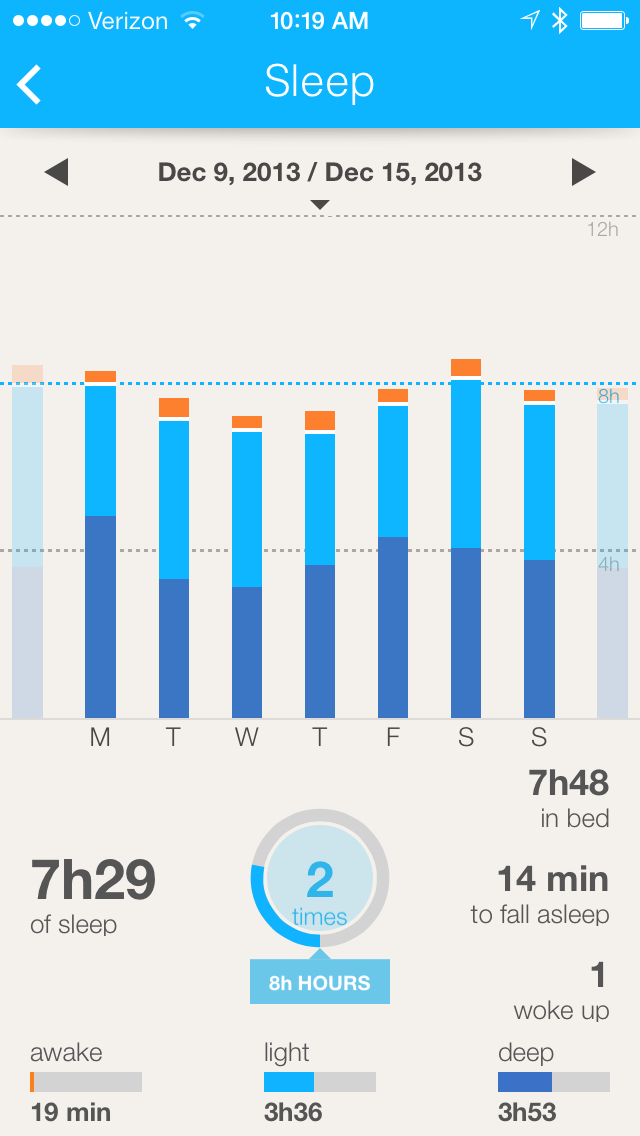
Sleep tracking is the other cool feature of the Pulse.  The other activity trackers I’ve seen will tell you the amount of time you spend in bed, but to me that’s not nearly as useful as the quality of sleep you get during that time.  The Pulse tracks light and deep sleep, which I assume it’s using the heart rate sensor to help detect (the wrist band has a window to provide a clear sight between the heart rate sensor and your skin).  It also detects time spent awake, though I find that’s not very precise.  As with activity tracking, sleep tracking data is displayed as either weekly summary, or daily view, as you can see in the screenshots below.  What I find really interesting is how sometimes the amount of deep sleep I get is not very dependent on how much time I spent in bed.

 sleep - weeksleep - day
The sleep tracking is really cool to review, especially when you start looking for correlations between how much deep sleep you get, and how you feel the next day.  It’s probably my favorite feature of the Pulse, and what really sets it apart from the other fitness trackers I’ve seen.


The iPhone app will also show data for heart rate measurements, though that isn’t of as much interest to me.  But hey, if that’s your cup of tea, this product also works great for that!  You place your finger on the rear of the Pulse and select the heart rate option on the screen to perform a quick measurement.

The Pulse can be purchased for $100 from Amazon and is well worth the money, provided you pair it with the iPhone or Android App to get the most out of the data.  I have concerns about the longevity of that velcro wrist strap (I worry the velcro will not hold as tightly over time), but this is such a fast-evolving technology that I expect I’ll be replacing my Pulse with a next generation product before that becomes a real issue.

SketchFab – the ‘YouTube’ for 3D files


Lotus Elise.lwo (click to view in 3D)

;

Lotus Elise.lwo

Creators of 3D files have had a real challenge in sharing those files with other users easily.  They can post 2D screenshots, or provide 3D files which must be downloaded and opened by somewhat specialized software.  SketchFab is providing a great alternative – you upload your 3D file, then can embed it (just like with YouTube videos) in your Kickstarter campaign or whatever, with the users able to view, rotate, zoom, your model just from their web browser – no special software or downloads needed.  It’s not a way for people to download files – just a way to help them view what you’ve already created.  You can see it in action firsthand in the Lotus Exige model embedded above.  Pretty cool.  Check out more here or read more at Forbes.com.

UPDATE – well, the first time I embedded this in my post, it worked as intended – all spinning etc from the preview window above. Now it’s linking to an external site…I’m not really sure why? Immature technology perhaps…but still very promising. Also note that the model above is incorrectly named by its creator…the engine cover on this car makes it clear it’s an Exige, not an Elise!

Century old film negatives found in Antarctica

antarcticaAlmost a century ago, Ernest Shackleton‘s Antarctic Expedition (1914-1917) left some film negatives in Captain Robert Falcon Scott’s former hut (from his failed 1912 expedition to become the first to reach the South Pole).  Amazingly, it’s taken until now for these negatives to be (re)discovered by New Zealand’s Antarctic Heritage Trust.   It’s pretty cool that the negatives are in such relatively good condition, but it also makes you realize how fragile our current archiving of our lives is – we are totally dependent on relatively fragile digital media.

Read more over at CNN, or check out all the photos here.

The never-ending NSA scandal

300px-Ingsoc_logo_from_1984.svgThanks to Edward Snowden, the NSA revelations keep hitting us…and it’s like some Hollywood movie plot.  The latest have been that the RSA installed backdoors into its encryption software for the NSA, and now comes word that the NSA sometimes intercepts shipments of new laptop computers to install spyware on them.  I do wonder if all these revelations are true or not, but the reality is that enough of them seem to be true, that the one truth is we cannot trust the NSA to be honest with us.  That, and US laws that restrict people from discussing these issues, mean the truth is difficult, or even impossible to discern.  For a supposedly free society, that’s a big concern.

Play old console games in your browser!

bezerkPut aside any thoughts of working next week…thanks to the Internet Archive, you can play most of your favorite old console video games for free right from your browser!  My favorites are the Atari 2600 ones, but you’ll also find Atari 7800 games, ColecoVision, Magnavox Odyssey, and Astrocade games.  Game quality is just as you remember (for better or worse 😉 ), though in my browser at least, none of the games had sound.  It’s a nice, easy to use alternative to MAME and worth checking out here.

Google’s tracking you

Do you own an Android smarphone?  Chances are, you opted in to passing along location data to Google when you set up the phone…but did you have any idea just how extensive that is?  Google’s doing their part to be a bit more transparent here, giving you the ability to view all the location data they have on you.  Just go to the location history browser.  I wasn’t able to use this as I’ve always been an iPhone user, but this article at TechCrunch sheds some light on the level of detail involved.

There’s no reason to believe that Apple isn’t collecting a similar dataset on its users.  There are plenty of beneficial reasons for doing so, but any user of technology needs to be aware of stuff like this..if it bothers you, you can usually opt out.

Proudly powered by WordPress | Theme: Baskerville 2 by Anders Noren.

Up ↑