84mpg VW Passat

With all the hype about hybrid vehicles these days, people tend to forget about efficient gas and especially diesel cars.  VW is the leader in this with their TDI diesel, and just recently John and Helen Taylor set a new record for the longest distance driven on one tank of diesel – 1626 miles!  That averages to 84.1mpg in a STOCK 2012 VW Passat (the official EPA rating for this car is 43mpg…so much of this gain was due to driving technique no doubt).  No modifications, zilch.  They even included 120lbs of luggage to make it a realistic road trip.  With this sort of gas mileage in a mid-size German sedan, hybrids don’t look nearly as impressive.

Full press release after the break.

(via Autoblog)

Continue reading “84mpg VW Passat”

Solar powered boat completes round the world journey

I have mixed feelings about this one.  PlanetSolar is less than one day from completing a circumnavigation using a boat powered only by the sun; it’s taken them about 600 days to do this.  I’m not quite sure what they’re trying to prove here.  If you want to go ‘green’ on your trip around the world, solar just can’t compete with wind.  Sailboats are a proven ‘green’ technology that are faster and can go more places in the world’s oceans (PlanetSolar is limited more to the equatorial regions where the sun’s more direct rays result in more powered gathered by the solar panels).  Likewise, storms pose little challenge for sailboats but the cloud cover hurts the performance of PlanetSolar.  Yes, solar is useful even on sailboats for powering shipboard electronics, but when it comes to propulsion, the abundant wind on the oceans is a fantastic, proven resource.

A solar boat?  I don’t get it.  Hoist the mainsail, matey.

How differentials work

I’ve always loved this video…it explains how automotive differentials work (and why they’re needed).  It’s a seldom appreciated, little understood, but extremely critical part that you’ll find in any modern car or truck.  Good video for kids too!

Electric vehicles, and global warming

Sure, electric cars don’t burn gas, but their electricity has to come from somewhere and in many parts of the country, that means coal.  Surprisingly though, even accounting for that, an electric car still produces less global warming emissions than a gasoline powered car getting 27mpg, according to a new study.  Of course, 100% coal-sourced electricity is a truly worst case scenario, as natural gas, nuclear, and renewable sources also come into play.  Taking that into account, it turns out that about 45% of Americans live in places where the electric car emissions are equivalent to a 50mpg automobile!  37% have the equivalent of a 41-50mpg car, and 18% have a 31-40mpg equivalent.

The bottom line is, yes, electric cars still result in air pollution and global warming gas emissions, but they’re still far better than almost any car on the road today (the one exception I can think of being VW’s fantastic TDI diesel engine).  More importantly, as more renewable energy is plugged in to the grid, electric cars will continue to improve, and quickly outpace even VW’s best diesel efforts.

Read more at SmartPlanet or the Union of Concerned Scientists.

Volpe – miniature ‘car’

I use the word ‘car’ loosely here.  This four wheeled contraption, the Volpe, is like no other car you’ve seen (well, apart from the Peel P50 with which is shares more than a passing resemblance!).  It’s a two seat four wheeled car, powered by an electric motor with a natural gas or gasoline generator providing extended range capability.

The seating is tandem style, and if you look at the image you can see how this would be a great setup for a rear passenger that has no legs.  So, let’s be realistic here and call it a single seat car.

Why would you want one?  Well, efficiency for starters…being so small, electricity usage is small as well.  Parking is a cinch.  It’s even small enough to find some creative parking places, like inside (it’ll fit inside an elevator).  It could actually make for a decent commute vehicle in large cities, as long as you can avoid freeways and other faster roads.

As mentioned previously, the Peel P50 was actually first with this ‘mini car’ idea, and my favorite TV show, Top Gear, had a great review that shows this car in real life, check it out below.  I expect driving a Volpe around town would have similar advantages…and drawbacks (the Peel P50 is smaller, though).

Specialized Turbo e-bike

Specialized Bicycles has unveiled a new electric-assist bicycle, the Turbo.  Like other e-bikes, it uses an electric motor to supplement normal pedaling, offering both higher top speed and increased range.  In this case though, it’s that top speed that’s a bit of a problem.  It seems the aptly-named Turbo is just too fast to be legal in many places (like the US), topping out around 28mph.  So for now, availability is limited to some areas of Europe, but it also seems that a simple design tweak could reduce its top speed to a more legal level for broader appeal.

More pictures can be found here, or check out the video below.

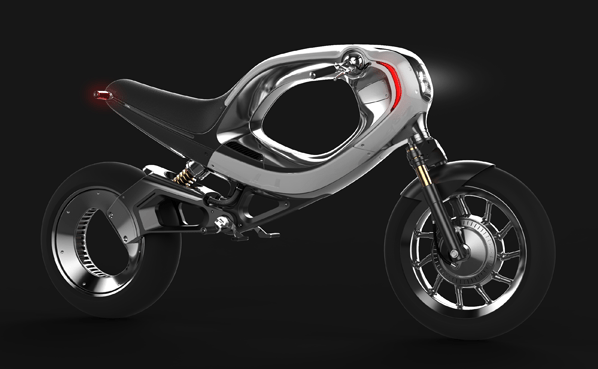
eBike concept

When I saw this eBike concept from Frog Design, my initial reaction was, look at all that wasted space in the middle section where a larger battery could reside.  It’s a trap I fall into sometimes…trying to optimize any design for function and performance, while ignoring what is perhaps the most important element of any product design.

Emotion.

That center void in the bike concept?  It looks cool and creates flowing curves, further enhanced through the use of materials, colors, and illumination (check out some of the other pictures for that).  The emotional attachment between a consumer and the product is absolutely critical.  Not to say that technical performance isn’t, but you can’t have one without the other.  Apple’s iPads and iPhones are great examples of that, where the form factor and graphical user interface create a welcoming experience for the user and ultimately a very successful product.

With the miniaturization of technology, more and more emphasis will be placed on the emotional side of design.  I mean, who wouldn’t want to own a lightcycle if given the chance!

PiCycle electric bikes

With gas prices rising and expected to continue to do so for, well the rest of our existence, alternative forms of transportation are becoming more and more appealing.  Electric bicycles are one option that offer some great functionality with few compromises.  Towards the higher end of the spectrum is this $6k PiCycle Limited bicycle from Pi Mobility, which offers a 35-45 mile range at 30mph.  Sure, it’s pricey for a bicycle, but when you view it as more of a replacement for a car, it becomes incredibly attractive, especially when you consider the very low maintenance cost and low energy costs.

They also made a cool commercial for this, check it out after the jump below.

Continue reading “PiCycle electric bikes”

Aircore Carbon fiber wheels

Hollow, one piece carbon fiber wheels?  Cool use of technology here.  With the only bit of metal being the filler valve, these wheels are incredibly light and strong, something you really do need on a car that’s expected to be capable of 270mph, the Koenigsegg Agera R.  Designing a wheel for high speeds is no small task….the 253mph Bugatti Veyron, for examples, requires its wheels to be stress tested or replaced at every fourth tire change (at a cost of >$10k each!).  Of course, carbon fiber wheels are relatively new to applications such as this, so owners may yet be stuck with comparable replacement costs.

Now, back to reality and perspective here.  How does a 1140hp, 270mph car make any sense whatsoever?  I love cars, really I do, but this is just a ridiculous machine that serves absolutely no purpose except to further enhance consumerism and deplete this planet’s natural resources.  It’s a joke. A fast, impressive joke, but a joke nonetheless.

Smart Parking

Finding a parking spot in a crowded city just got a whole lot easier!  San Francisco has embedded magnetic sensors under 8200 parking spaces throughout the city, to detect the presence of a car, and has made this information available to all at the SFpark website.  It doesn’t show individual spots, but gives a block by block status of congestion, with estimated number of spaces available in each, along with the parking rates for different times of day.  Pretty cool!  And yes, ‘there’s an app for that‘ too…

Proudly powered by WordPress | Theme: Baskerville 2 by Anders Noren.

Up ↑