Amazon launches Vine, an eco-friendly shopping site

Amazon has started a new e-commerce site, Vine.com, where they’re focused on selling environmentally-friendly products.  Vine offers free two day shipping on orders over $49, 95% recycled shipping boxes, and supposedly intelligent shipping software to ensure an appropriate box size (without all the wasted space I often find in Amazon packages).  They have a pretty broad selection of green products, such as seeds from Seeds of Change, organic catnip for your cats (really), recycled toilet paper, yoga supplies, and, well, you get the idea.

It’s always best to BUY LESS STUFF…but when you do need something, buy eco-smart…and websites like Vine help out there.

Shopping for Quality Camping Gear

One of the best things you can do for this planet is, if you have to buy something, shop for quality. Buy something that will last as long as feasible, not something designed to be thrown away and replaced in a short time. For camping, I came across a great article in TheGoodHuman with information and links to sources for quality camping gear. Tents, sleeping bags, etc. Check it out!

Eneloop Rechargeable Batteries

In my opinion one of the easiest things you can do today that’s also great for the planet is to invest in rechargeable batteries.  Not only do you reduce the waste that either ends up in landfills or has to be recycled, but you also save money in the long run.  My favorite has been eneloop batteries (a NiMH application), and we’ve completed a transition of our household to these.  If you’re new to this, start with the starter kit pictured here, as includes a charger, a selection of AA and AAA batteries, and adapter pieces to use AA batteries in place of ‘C’ or ‘D’ batteries.

Why do I like eneloop?  Reasonable cost, more than 1500 charge cycles, and they hold their charge a long time when not in use.  I’ve been using them for over a year now and have had no complaints, it’s a good product and worth checking out.  I just wish they’d make rechargeable 9 volt batteries for all the smoke detectors in our house!  I found some by Tenergy that look promising, though I have not yet tested them for long term use in smoke detectors…that’s my next battery project.

If you’re not convinced and are instead wondering which disposable battery is best, check out batteryshowdown for some comparison tests of those.

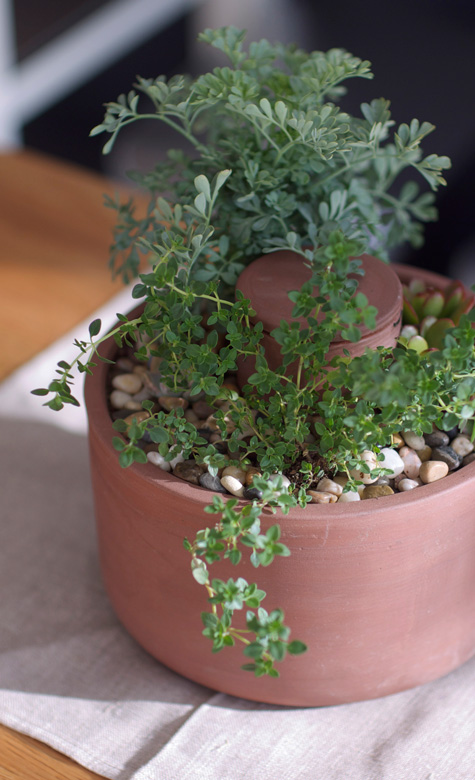
Self-watering earthenware planter

The idea behind self-watering planters is pretty simple – they’re basically pots that hold extra water, designed to provide water as needed to the plants without drowning their roots.  Usually, however, they’re made from cheap plastic, or else are DIY adaptions of ceramic pots.  Here’s a cool one though from from designer Joey Roth, made from unglazed earthenware.  The center column holds the water, and since the pot is porous, water can seep out as needed into the surrounding soil.  Simple, eco-friendly, and looks great too.  Available for $45 preorder at this website.  Apart from decorative purposes, one great use for this would be as a small herb garden!

(via CoolHunting)

The case of the extra water

Over the past forty years or so (1961-2003), global sea levels have risen an average of .07″ per year.  Global warming is largely the culprit here, but scientist have struggled to truly make that hypothesis work.  You see, when you account for global warming’s effects on the oceans  (slightly lower density at higher temperatures, and melting ice), the numbers don’t add up…that only accounts for about .04″ of the .07″ per year rise.  Where’s the rest coming from?  Scientists in Tokyo believe the answer is all around us.  Or rather, it IS us…the extra water in the oceans is due to extraction of water from underground aquifers over the past many decades, which is not being replenished at the same rate.

So why does this matter?  Look, the aquifer levels are decreasing (in many areas at least). Forget the ocean for a minute, our lifestyles are not sustainable like this and it’s immoral to pass this problem on to future generations, not when we see it happening around us and have the technology to fix it.

Based on current sea ice melting trends, sea levels are expected to rise 3-5 FEET by 2100.  Living a sustainable lifestyle with water usage can help with that, though we really need to be addressing global warming as well.

(via Phys.org)

Bleak outlook for Earth

Things aren’t looking good for this planet.  The well-respected group of scientists known as the Royal Society is concerned about the combination of excessive consumption and population growth, and is suggesting increased birth control and global redistribution of wealth to combat that.  Two things that are politically untouchable in this country at least.  This is the problem I see…scientists look at the path we’re on and have recommendations for how to fix it, but the political and social reality is not guided by science, it is guided by other influences.  Scientists, in general, just don’t seem to get this…they keep talking about what should be done to solve the world’s problems, without recognizing what can be done.  We don’t need talk about ideal solutions, we need talk about practical, realistic solutions.  Changes that you can possibly expect might be implemented.  You can read more about the Royal Society’s position on these issues in Scientific American.  And no, I don’t have the answer…I’m just really pessimistic about global governments’ abilities to enact change, and get frustrated when the best answer I hear from scientists is to let global governments solve these problems.  It’s not going to happen, we need new ideas.

In separate, but related, news, the executive director of the International Energy Agency is warning governments around the world that, globally, fossil fuel consumption is increasing and we need to shift our focus to renewable energy sources.  On our current path, we’re looking at a global temperature increase of 6C by the end of the century, triple the international ‘goal’ of 2C (though I’d argue that the goal should be zero!).  We’re just nowhere near where we need to be, and there’s no real drive for change.

Bleak news, but then, it’s not really news…it’s just more of the same.  We recognize the problem but instead of taking responsibility for our actions, we’ll pass this off to the next generation and make them deal with it.  This is our legacy, but I hold out hope that we can find technological solutions to these social problems before it’s too late.

Mining Asteroids

So, it comes to this.  Natural resources are becoming scarce enough that people can have serious conversations about mining ASTEROIDS and be taken seriously.  Not that it can’t be done, but wow…we are so far from living in balance with this planet that we need to exploit other areas of the solar system to sustain our lifestyle?!  Although, it may not be as bad as it first sounds.  Rather than bringing those resources back to this planet, it’s far most cost effective to use them to supply spaceships and colonies on the moon or Mars and that seems to be the main intent of Planetary Resources Inc.  Which makes so much more sense considering we struggle to get enough public support for a mere six person orbiting space station.  Maybe capitalism will succeed where every world government has failed…

The Earth is full – CNN.com

How many people can this planet support?  According to Paul Gliding, The Earth is full.  Or rather, it’s not the number of people that’s the problem, but the amount of resources we require from this plane to sustain our economies.  It’s possible to transform our economies to live in balance with this planet, but let’s face it, that’s not going to happen until we reach the breaking point first, and that’ll probably be within our lifetimes.  I’d like to believe that my blog will help influence enough people to achieve change here…but I admit I’m pessimistic, due to the global cooperation required.

Here’s his TED talk:

Recycling – from bottles to sweatshirts

We’ve always taught my daughter to recycle, but for kids, it’s hard to picture just what that means.  The bottles go into a different trash can, but so what?  What happens then?  Well, if it’s plastic bottles, they may end up recycled into clothing, and that’s what I loved about the video here – it allowed me to show my daughter what it means to recycle.  She was a bit puzzled when I first told her that I was wearing a sweatshirt made from water bottles, but showing her this video really helped her visualize how that’s possible.  If you have kids, or are just curious, it’s worth checking out:

Proudly powered by WordPress | Theme: Baskerville 2 by Anders Noren.

Up ↑