Early-warning test for Alzheimer’s is 100% accurate

Researchers at Neurotrack have developed a computer-based cognitive test that can predict, with 100% accuracy, whether someone is likely to develop Alzheimer’s within six years.  Being given such advanced warning is a huge benefit, as it opens up possibilities for slowing the onset of this crippling disease.  Despite that 100% accuracy claim, it sounds like there IS a bit of uncertainty in the test.  If you score below 50, that’s where the 100% chance of Alzheimer’s applies.  Score about 67 and you’re in the clear (well, for six years at least).  It’s those people who score between 50 and 67 that are in a gray area…I suspect the diagnosis there would be to repeat the test every year.  Considering that it’s a fairly simple test to take, I don’t think that would be a big burden at all, just a minor inconvenience and part of growing old.  They’re even looking at adapting this test for iPads, something that people could then self-test at home!

You can read more over at Counsel&Heal.

Negative health impacts of too little sleep

I came across a really interesting article over at Care2 that talks about the health impacts of not getting enough sleep.  I think everyone knows they ‘should’ get plenty of sleep, but why?  Just to feel happier?  Nope.  It turns out that not sleeping enough can affect many aspects of your health:

1. Neuropsychiatric disorders, impaired alertness and cognition, and headaches
2. Vision problems, including blurred vision, floppy eyelid syndrome, glaucoma, even temporary blindness
3. High blood pressure
4. Increased levels of cortisol, a hormone associated with stress
5. Cancer
6. Difficulty with sexual functioning
7. Increased food cravings and hunger
8. Insulin resistance, type 2 diabetes
9. Hearing loss
10. Muscle weakness and decreased athletic performance
11. Heart disease
12. Skin problems and rashes, including eczema
13. Hair loss
14. Disrupted metabolism, weight gain and obesity

Or to put it another way…just about everything you can think of.  My personal metric for whether I’m getting enough sleep, is if I wake up on my own, feeling well-rested, before my alarm goes off.  For me, it’s just a matter of getting to bed at a decent time and letting the body do its thing.

A retinal implant to restore sight

the-alpha-ims-subretinal-implant-300x247Right off the bat, realize that this isn’t about restoring 20/20 vision to blind people…but rather, helping those who lost their sight due to medical conditions (in this case, retinitis pigmentosa) restore partial vision.  It’s amazing technology…a retinal implant uses a 1500 pixel sensor to receive light through the eye, and transfers it (via electrical signals) to the nerves in the eye for processing by the brain.  This gives these people a very rudimentary level of vision, but adequate enough to detect the objects around them, make out the horizon, houses, trees, rivers, cars.  Close up, they can even tell if someone is smiling or wearing glasses.  Pretty amazing tech.

(via SmartPlanet)

TSA to stop using all x-ray body scanners

rapiscansecure1000sp__small_customThe TSA has announced that it plans to remove all x-ray (or backscatter, as it’s also known) body scanners and use only the radio-wave based scanners.  The backscatter technology has received much criticism over health concerns and a lack of scientific testing to show they’re safe, and while the TSA finally started investigating the health risks associated with those machines in December of 2012, they say the decision to stop using these machines is due to the company’s inability to provide a timely software upgrade that would replace the actual image of the passenger with an avatar or other abstract graphical representation.

I’d written about the concerns with backscatter technology previously, and am hesitant to get too excited about this news.  My concern now is that the study into the health effects will be terminated (as it should, to save money), yet OPI Systems (the backscatter scanner manufacturer) will upgrade their software and slightly change their hardware to allow them to release a ‘new’ model of scanner later this year which the TSA will then accept as a replacement for the 174 backscatter machines currently due to be sent back to OPI.  Since it’s a ‘new’ machine, it’ll restart the clock, so to speak, for getting the TSA to begin investigating the health impact of it, then there will be a long, protracted study, etc, with the technology being used all the while.  Of course, that’s just my pessimistic speculation..for now, it’s a victory for health as the machines are due to be removed and replaced with a safer technology.If you’re curious..check out this link for a good side by side comparison of the two scanner technologies.

DNA photographed

Using some cool trickery with silicon nanopillars and an electron microscope, scientists in Italy managed to photograph and actual strand of DNA, including the closeup image below where you can start to make out the double helix structure.  Impressive work!

You can read more about it in The Atlantic.

Crowdsourcing medical research

Researchers in Sweden have developed a genetically engineered virus that they believe may be able to fight some forms of cancer.  While that sounds great, they ran into a reality check when they looked at doing clinical trials…what they need to do to truly test this virus is going to cost one heck of a lot of money, and finding backers for that is not easy.  So, they’ve turned to the internet for help, hoping to raise around three million dollars to allow them to tackle the first phase of the clinical trials.  If that test is successful, the hope is that it would spur enough interest from big companies to foot the bill for continuation and completion of testing.  You can read more about it here, or check out the video below.

Possible link between Alzheimer’s and diabetes

The NYTimes has an interesting article in the opinion section suggesting that Alzheimer’s could be a form of diet-induced diabetes (‘type 3 diabetes’, they call it). It’s far from definitive at this point, but what IS clear is that eating sugars and carbs has more downsides than upsides. Really no upsides, actually, just downsides! But that’s a subject I’ll be covering more in this blog in the coming weeks and months.

In the meantime, you can read more over at the New York Times.

Nearly Instantaneous DNA Analysis

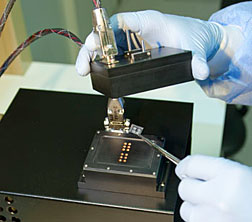
Scientists and engineers at Lawrence Livermore National Laboratory have managed to vastly decrease the time required to analyze DNA samples, by accelerating the process whereby samples are amplified for analysis.  This is expected to lead to a 5-10 minute DNA test cycle, which is a huge improvement over the hours or days it takes now.


So how will this affect you?  The example in the article at phys.org says it best, so I’ll just quote it here:


Picture this: You’ve brought your sick child to the doctor’s office. After checking her pulse and blood pressure, he takes a nasal or throat swab and inserts it into a mysterious black box. Before the doctor finishes his examination, the black box beeps, indicating that the pathogen that’s making your child sick has been identified.

(via Phys.org)

Proudly powered by WordPress | Theme: Baskerville 2 by Anders Noren.

Up ↑