Arctic Ice Reaches New Minimum

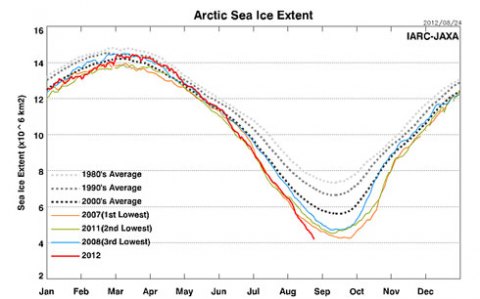
Weeks ago, the extent of ice in the arctic had already reached record lows and was continuing to melt as we reported here.  Now, the melting has stopped (as expected for this time of year).  So, how bad was it?  According to the NY Times, the low point was about 1.32 million square miles, or 24 percent of the Arctic Ocean (the previous low was 29%, set back in 2007).  It used to be around 50% when satellite-based ice tracking began back in the 70’s.

The question is, what’s it going to take before people get serious about halting global warming?

Arctic Sea Ice Vanishing

It seems to me that every year or so for the past decade, I’d see a story in the news reporting on the minimum extent of arctic sea ice, comparing it to previous years, etc.  Sometimes it’d be reaching a new minimum, sometimes it’d be the second or third worst on history.  This usually occurs around late September or early October, when arctic sea ice usually hits its minimum for the year.  So, it’s too soon to be hearing doom and gloom about the arctic this year, right, since we’re still in August?

Nope.

As the graph above shows, we probably haven’t reached the 2012 arctic sea ice minimum point yet…but we have already set a new record for minimum sea ice extent in the arctic.  If historic trends prove true, we have another month of so of melting before we reach the actual minimum for this year.  2012 is, unfortunately, providing global evidence of the impact our species is having on this planet through CO2 emissions and global warming.  While the technology exists to halt this slide into oblivion, we so far lack the willpower to do something about it. On the contrary, the Republican party is in outright denial of the issue, and a very large percentage of Americans are blindly following along.

What will it take to convince people that preserving this awesome planet for future generations to enjoy is worth a bit of personal sacrifice?\

(via climatecrocks.com)

More bad news on the climate

More bad news on climate change…a prominent scientist in the UK (Sir Robert Watson) is now saying that the goal of a 2C global temperature rise is ‘largely out of the window’ and that 5C is a more realistic expectation.  This is bad…it’ll affect food and water supplies, not to mention increasing sea levels and population displacement.  This doesn’t have to be our fate…we have the technologies needed to reduce greenhouse gas emissions dramatically, let’s us them!
Read more about this and what he has to say over at the BBC.

Are we past the point of ‘acceptable’ climate change?

Have we passed the point of ‘acceptable’ climate change, if there can be such a thing?  It’s a difficult question to answer, for climate is a complex system and our impact on it takes some time to realize.  More and more though, I’m hearing scientists speak up with concern about where we’re at now.  It would be easy to downplay that if our species was making significant progress towards reducing CO2 emissions to zero, but when you see those emissions increasing instead, you can’t help but be concerned.

The latest article I’ve found is in Scientific American, and basically talks about how the CURRENT levels of CO2 in the atmosphere are going to lead to really bad changes (‘catastrophic’ is the word used, but I like to remain at least a LITTLE optimistic…).  The scientifically agreed upon ‘goal’ for atmospheric CO2 concentration has been 350ppm (parts per million).  The problem is we’ve already passed that, currently sitting at about 390ppm with only increases in the forecast. (read more here)  The group 350.org is a great source to follow for more information about this goal, too.

The most frustrating part?  It doesn’t need to be like this.  We don’t need a revolution in technology to reduce our CO2 emissions dramatically (cutting CO2 to zero probably would require some radical new technology, but we can benefit a lot just by going after the low hanging fruit, so to speak).  The technologies already exist to provide most of our energy in clean forms…we just lack the political and social willpower to do anything about it.  Perhaps that can change…and it’s that hope that leads me to keep posting to this blog, in a perhaps futile attempt to influence others globally and enact change.

Climate Change is Simple

I really like this TED speech from David Roberts, called ‘Climate is Simple‘.  Well I like how he presents the facts…but I don’t like hearing the conclusions (though I don’t dispute them).  He sums up where the climate has been, where we’re at now, and where we’re headed.  It’s that last part that scares me…we’re on the verge of ruining this planet for future generations.  What gives us the right to do that?  I believe we should preserve this planet for future generations to enjoy…not alter it for future generations to suffer and face a lesser quality of life than us.  If you agree, it’s worth watching this video:

Climate Change and Skeptics

Jerry Brown, governor of California, has a launched a new website discussing climate change…but the real gem of it is the section devoted to climate change skeptics (or ‘morons’, as I like to refer to them).  It does a good job of presenting rational responses to the arguments skeptics typically make.  Not that skeptics are interested in rational responses and those annoying things called ‘facts’, but hey, it might make you feel more confident when debating climate change with someone.  Or it might just make you depressed that only about half of Americans believe that people are responsible for this.

Check out the Climate Change Deniers section when you get a chance.

Also keep in mind that what matters with climate is the trends over several years, you can’t draw conclusions from just one year.  The past 12 months have been record-setting, sure, but using that to support your position when debating climate change puts you on thin ice (so to speak).  Stick to the science…one year is interesting, but decades are what establishes scientific fact.

July 2012 the hottest month EVER

The dust bowl summer of 1936 was a hot one, and until this year, the hottest on record.  No more.  July 2012 is officially the hottest month ever recorded in the continental US.  We also set a record for the warmest January through July period, and for the past 12 month period of time.

Climate change is real, it’s happening, and the worst part is yet to come as atmospheric CO2 levels continue to rise unchecked.  Scary stuff.

Read more here.

Climate Change Skeptics Reverse Course

Finding a climate change scientist who does NOT believe that people are responsible for global warming is pretty hard (the commonly-reported estimate is that 98% of climate change scientists are in agreement that people are mostly responsible for climate change)…and it’s getting harder.  One of the more prominent skeptics, Richard Muller, has accepted the scientific evidence and is no longer a skeptic…he was part of a team of more than a dozen scientists at the University of California, Berkeley that have been studying global warming, specifically with respect to how global warming correlates to human and natural events, to try to determine the cause.  What they found was that the average land temperature has increased by 1.5C over the last 250 years, and that “”the most straightforward explanation for this warming is human greenhouse gas emissions.”  Most of that increase has been in the past 50 years, too.

I think former skeptic Muller put it best when he said, “While this doesn’t prove that global warming is caused by human greenhouse gases, it is currently the best explanation we have found, and sets the bar for alternative explanations.”  This is what science is all about.  Recognizing the facts, but also maintaining an open mind, for science is rarely 100% certain about anything.  Perhaps some new hypothesis will be put forth that shows that CO2 is NOT responsible for global warming, but until such a hypothesis is presented and proven, we need to stop this media debate over global warming and report the scientific facts.  The media needs to stop giving air time to climate change skeptics who don’t have the science to back up their claims…for doing so only works to legitimize their ideas in the mainstream public’s minds.

The project’s official website is here, where you can view full results of this study.  Or, read more about it over at The Guardian.

Overreacting to climate change

The droughts and wildfires that have hit this country are signs of what’s to expect with climate change in the coming years, but here’s the thing…people are, I fear, overreacting to this.  Meaning, they’re looking at what’s happening and saying that climate change is here, this is the new norm, etc.  While that’s mostly right, climate is a variable thing and you need to look at long term trends.  I have little doubt that, long term, yeah, this is the new ‘norm’.  I also have little doubt, though, that in the next year or two, we’ll probably get a lot of rain, maybe cooler temperatures, and people will then use that as an argument to attempt to refute the idea of climate change, to try to convince others that there’s no threat.  Just keep a level head about you, this year was bad, future years will seem better, but you need to look at long term trends of many years when you look at this global climate.  Those trends make it clear that the planet is warming, and what’s really scary is that we’re already experiencing bad weather, when the worst impacts of climate change aren’t forecast to happen for many, many more years to come.

26 states are natural disasters due to drought

26 states have been declared natural disasters due to drought.  Crops are withering.  While it’s not possible to tie one year of weather to climate change, this is just another data point in a continuing trend, one that’s going pretty much as climate scientists have been predicting.  Another result has been the wildfires in Colorado.  Increased rainfall in the Pacific Northwest.  These are, most likely, not ‘abnormalities’, but rather the new norm…and we’re nowhere near predicted levels of global climate warming, that’s still decades away (or more, if we don’t find a way to drastically cut CO2 levels).  If we were to slash CO2 emissions to zero this year (great TED talk from Bill Gates here on that topic), much of this could be held at the levels we see now (except that sea level rise would continue for quite some time).  The chances of that happening are zilch, I’d say.  Expect weather extremes to get worse, and be ready to adapt the best you can.

Proudly powered by WordPress | Theme: Baskerville 2 by Anders Noren.

Up ↑