Researchers at Wake Forest University are working on a cool nanotech application – developing a fabric-like material that generates electricity from body heat. It’ll be neat to see if something like this reaches the mainstream market. Read the full paper here, or check out the CNN video below.
Catalytic-driven hydrogen generation
I’m seeing more and more reports of studies involving the use of catalysts to generate hydrogen. This is a fascinating development, so I’ll be posting more of those here (follow this link for a description of the work CalTech is doing on this). The basic premise is to heat water to a point where an added catalysts splits the water molecules into their oxygen and hydrogen components, the hydrogen is then used as fuel. More importantly, the hydrogen can then be stored for later use. For example, imagine a solar thermal collector used to generate the heat to drive this reaction, with excess hydrogen being stored for use during night. It’s a sort of hydrogen battery, if you will.
This research is still in the laboratory stage, but is an interesting path to sustainable energy solutions which address the energy storage concerns.
NREL energy analysis
The National Renewable Energy Laboratory (NREL) has published a study that looks at the extent to which renewable energy can meet the demands of this country over the next few decades. What they found was that existing technologies, that are commercially available today, are more than sufficient to provide 80% of total electricity generation by 2050.
No one wants to pay higher prices for electricity to fund this, but the reality is that the course we’re on is unsustainable and change is inevitable. The sooner we begin that change, the smoother it will go. So what are we waiting for?
Advances in Solar Panel Technology
Solar energy technology is advancing fast enough that I’ve decide to lump together several updates into single posts now and then.
To start with, the Frauenhofer Institute has showed off some highly flexible solar panels, placing them on a ski helmet. This may not sound like a big deal, flexible panels have been around for a while, right? Well, not really. Typically, when you see a flexible panel, it can only bend in one direction – around a cylinder, for example. This new technology allows the panel to conform to compound surfaces, like a sphere or, in this case, a ski helmet. For now, testing this on ski helmets is a good, extreme use environment (the solar cells become more efficient with cold, but batteries become less efficient). Just about ever helmet design could benefit the user with this – motorcyclists, construction workers, bicyclists, you name it. The first product, a ski helmet, is targeted for sale at the end of 2012.
Solar cell comparisons invariably come down to one key metric, the efficiency. Going along with this is measuring reflectance, or how much solar energy is reflected and thus unable to be converted into electric energy. Scientists at Natcore Technology have set a new record for this, producing wafers that absorb an incredible 99.7%! This promises to increase solar panel efficiency, which in turn will lower cost and increase adoption of solar energy worldwide.
There are two main types of solar energy devices on the market today – photovoltaic panels that covert visible wavelengths into electric power, and solar thermal that takes the abundant infrared radiation emitted by the sun and uses that heat energy to do the same (via turbines or other methods, or just using the heat directly to heat a house or water heater). Now, Naked Energy has designed a hybrid solar energy system which has solar panels to make electricity, but also pumps water through the tubes to make that heat available for other energy uses (heating a house being the most feasible). It’s not a utility-scale sort of system, but great for home or business users.
Self-sustaining solar-powered Hydrogen generator

 Engineers at the University of Delaware have developed a prototype hydrogen generator that has the potential to revolutionize solar energy production. Solar thermal energy is used to vaporize zinc oxide powder. This gas is then reacted with water to produce hydrogen gas and zinc powder (which can then be fed back into the system). The shortcoming of any solar energy system is energy storage, and a system that produces hydrogen gas solves that as the gas can be stored for later conversion to electrical power in a fuel cell.
The system requires further testing but it’s off to a promising start! Read more at Physorg.
Electricity From Ambient Heat
While there are many methods of converting heat energy into electrical energy, they’re typically inefficient (thermoelectric) or need to be done at a larger scale (steam turbines). Researchers at the Hong Kong Polytechnic University are showing promising results with a different approach. You see, the atoms in a liquid are in constant motion. They found that when copper ions collided with a strip of graphene immersed in a solution, the collision dislocated an electron out of the graphene, and it then traveled through the graphene strip, essentially replicating the function of a battery and illuminating an LED as a result.
As with any science, further tests are needed to verify the reaction and rule out secondary effects being responsible (such as chemical reactions). If validated, though, this has enormous potential, for it would enable the generation of electrical energy from any heat source (something planet has no shortage of). It’ll be interesting to see if this pans out.
Read more here.
Solar power…from grass?
Can we generate solar power from grass? Researchers at MIT think this might be a possibility. While efficiency is low, the real metric to look at is energy per unit cost. Watch the video below for some really interesting information on this.
Solar Power in the Developing World
Watching the propagation of technology throughout our global society can be fascinating. Case in point, the telephone. First world telephone users started with hard wired phones, which transitioned to cordless phones (still using the wired infrastructure), and are only recently transitioning en mass to cell phones. In developing countries, the infrastructure for a wired phone system simply doesn’t exist, and is very expensive to install. These same countries are finding that cell phones are less expensive to deploy on a wide scale, and as a result these areas are incorporating phone technology into their lives at a different point in the cycle than first world citizens.
A similar technological lead-frogging is beginning to appear in energy. While first-world countries continue to burn fossil fuels and transmit that energy hundreds of miles through wires to the end users, the costs with building that infrastructure is making alternative energy, specifically solar, much more appealing to developing world citizens, where solar can be less expensive than the fossil fuel alternatives.
It’s a fascinating transition, and for more on this I recommend reading this article at climatecrocks.com.
Solar Panel Efficiency Gains

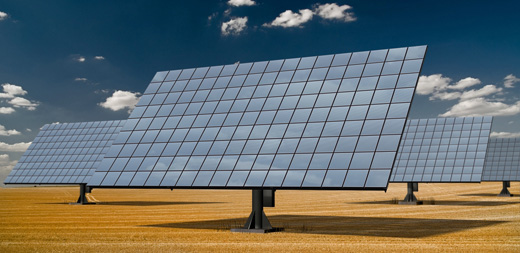 North Carolina based Semprius has set a new standard for solar panel efficiency at 33.9 percent! While only a small gain over the previous record of 32%, it’s nice to see this trend continue, as improved efficiency helps increase solar’s competitiveness in the marketplace. They accomplish this through the use of lenses and mirrors to focus the incoming light, a technique known as concentrated photovoltaics (CPV). They’re expecting production of this technology to begin in the second half of 2012, though it’s targeted more towards utility-scale installations, not residential owners.
Hyperion Solar Updraft Tower

 Hyperion Energy is looking to build a gigantic, kilometer tall tower in Australia. Where it really gets interesting is the ‘why’. The base of the two has holes in it. The land around it, for almost fourteen square miles, would be covered, creating an air gap between the ground and the cover. The sun would heat up the air under the cover, and hot air would rise up through the tower, drawing in cool air from the perimeter of the cover. Turbines installed in the base of the tower would be turned by the rising hot air, thus generating electricity. Perhaps the best part is since this operates on a temperature DIFFERENCE between the ground air and the air at the top of the tower, when night falls this will continue to generate electricity as the ground will retain heat while the air above the tower cools down. Natural power storage. So, not only is this clean, renewable energy, but…the plant pictured here would produce about as much electricity as as small nuclear reactor (200MW)! Awesome! They’re hoping to get this build and operational by 2014.
Hyperion Energy from Hyperion Energy on Vimeo.